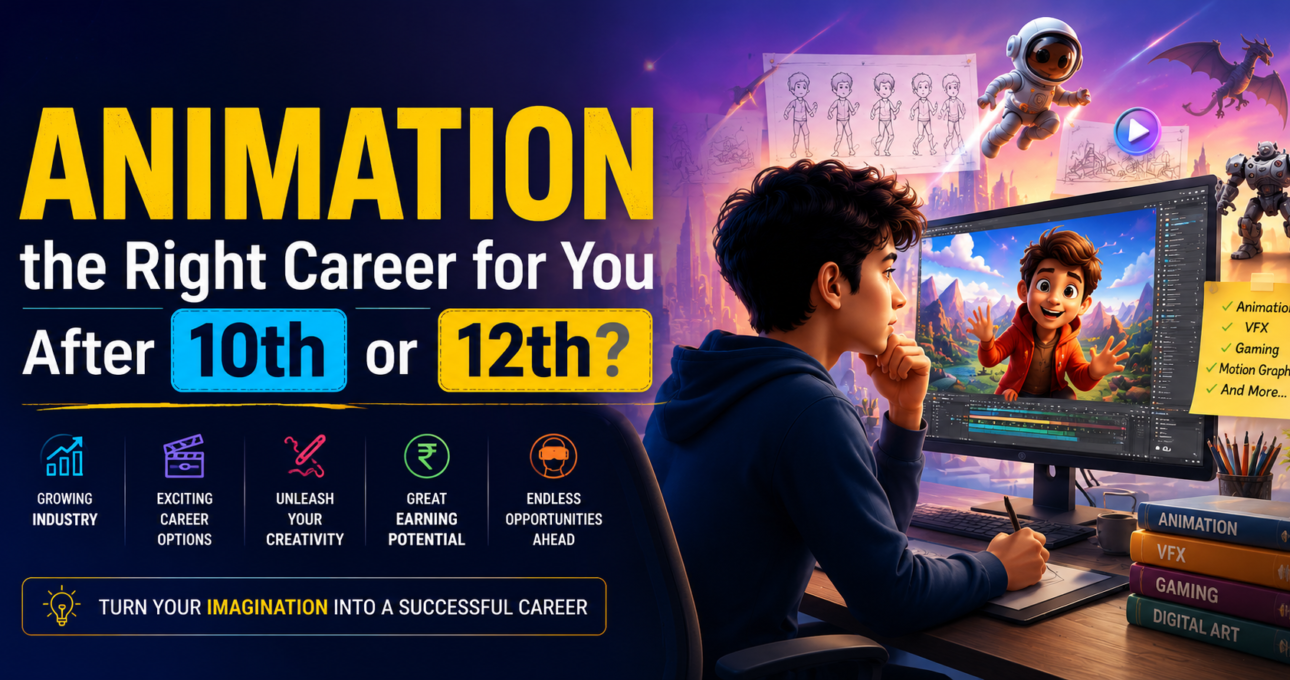
If you have been spending hours watching animated films, playing video games, or wondering how those stunning visual effects in movies are made, you are already thinking like an animator. Animation is not just a hobby interest, it is a full-fledged, growing profession with real career opportunities in India and globally.
Whether you just finished your 10th boards or are preparing to move on after 12th, an animation course can be the bridge between your creative instincts and a professional career. This guide breaks down everything you need to know: what courses are available, how much they cost, what the eligibility is, and where to find a solid 3D animation training institute in Chandigarh that actually gets you placed.
No fluff, no jargon, just the information you need to make a confident decision.
Why Animation Is One of the Smartest Career Choices in 2025?
India’s animation and VFX industry is no longer a small niche. It has grown into a multi-billion-dollar sector, with global studios consistently outsourcing work to Indian studios. The demand for skilled animators spans film, OTT platforms, gaming, advertising, architecture visualization, e-learning, and healthcare simulation.
Here is what makes animation a financially viable career today:
- Freshers with a diploma or degree in animation can earn between INR 2 lakh and 4 lakh per year.
- Animators with 3–5 years of experience often reach INR 4 lakh to 7 lakh annually.
- Senior professionals with 6 or more years can earn INR 7 lakh to 12 lakh or more.
- The gaming industry alone is projected to cross USD 7 billion by 2026 in India.
Companies like Tata Elxsi, DQ Entertainment, Prime Focus, and Reliance Animation are constantly hiring. Global studios also actively recruit from Indian 3D animation institutes because of the quality of output and competitive cost structures.
The scope of animation is not limited to Bollywood. OTT content demand, mobile game production, AR/VR development, and corporate explainer videos are all creating consistent employment for trained animators.
Animation Courses After 10th: Your First Step Into the Industry
Most students assume they need to wait until after 12th to start. That is not the case. If you have completed your 10th standard from a recognised board, you can enrol in a certificate-level animation course right away.
What Courses Are Available After 10th?
Certificate courses are the most accessible entry point. These are typically 3 to 6 months in duration and focus on foundational skills. Common programs include:
- Certificate in 2D Animation
- Certificate in Graphic Design and Digital Art
- Certificate in Basic 3D Modeling
- Certificate in Game Design Fundamentals
These courses are designed for students with no prior technical background. You will learn drawing basics, colour theory, character design, and how to use entry-level software such as Adobe Animate or Autodesk Maya’s introductory modules.
What Will You Actually Learn?
A good certificate program after 10th will cover: storytelling through visuals, fundamental drawing and sketching, digital tools and interface navigation, and basic principles of animation such as squash and stretch, timing, and anticipation. These are not just textbook concepts, they are practical skills you build through project work.
One thing to keep in mind: not every institute offering animation courses after 10th has the same quality of instruction. Look for institutes with trained faculty, working computers with licensed software, and a structured curriculum rather than one that promises a certificate after a few video lessons.
Animation Courses After 12th: Complete Course Breakdown
Once you have completed your 12th, the range of animation courses open to you expands significantly. You can choose from certificate, diploma, or full degree programs depending on how deep you want to go and how much time you want to invest.
Stream Does Not Limit You
Once you have completed your 12th, the range of animation courses open to you expands significantly. You can choose from certificate, diploma, or full degree programs depending on how deep you want to go and how much time you want to invest.
Types of Courses After 12th
Here is a clear breakdown of the main options:
- Certificate Courses (3–6 months): Focused, skill-specific programs. Great if you want to start working quickly. Cover areas like 2D animation, motion graphics, or basic VFX.
- Diploma Courses (1–2 years): More comprehensive than certificates. Popular options include Diploma in Animation and VFX, Diploma in 3D Animation and Film Making, and Diploma in Multimedia and Design. These are widely accepted by employers.
- Undergraduate Degree (3–4 years): Programs like B.Sc. in Animation and Multimedia, BFA in Animation, B.Des in Animation Film Design, or BA in Digital Film Making. These give you a well-rounded education and are best if you are aiming for senior roles or want to work in high-budget film production.
Average fees for animation courses after 12th range from INR 30,000 to INR 1.5 lakh per year for diplomas, and INR 80,000 to INR 2 lakh per year for undergraduate degrees (It Assumption not exact, for exact fees match go for institute). Government-recognized institutions are often on the lower end; private institutes with strong placement records tend to charge more but also offer better industry exposure.
Check Out Top Google Reviews
Trustindex verifies that the original source of the review is Google. Currently pursuing my diploma in VFX and animation and having best teaching facilities and teaching staff , everyone seeking future in this field should visit arena for best experience.Posted on GoogleTrustindex verifies that the original source of the review is Google. I have join the Arena Animation for gaining some in Graphic Design and Practical work Sketching and also in Advanced VFX and the teacher are very friendly and helping me while doing any task in graphic Design and Pre Production Sketching and also help me while having any doubt or query they solve it and also help me to gain some interesting knowledge about the graphic Design and Pre production sketching and the receptionist and also the Manager and the Head of Department are very nice to in Communicating and giving more about the course and software and practical work and also enjoy in event that the Arena Animation and also give me the Opportunity in the event to join and also participate in and also help me while understanding like how to make Cv and resume and portfolio and all the guideline they gave and giving the best company all around the world and also giving the best opportunities job all around the world and it very nice opportunity while joining this Arena Animation in ChandigarhPosted on GoogleTrustindex verifies that the original source of the review is Google. Arina Animation is a grade place for someone who would like to start his journey in designing, animation, 3D. The faculty is experienced and supportive. Individual attention is provided by the faculty. I have learned a lot of things throughout my journey here so far and would recommend it to anyone who would like to start their journey creatively in their field.Posted on GoogleTrustindex verifies that the original source of the review is Google. Arena Animation has been a great place to learn vfx, animation and design. The faculty is supportive, the labs are well-equipped, and the teaching is very practical. I've gained confidence in my skills and also got exposure to real industry practices. Highly recommended for anyone who wants to build a creative career.Posted on GoogleTrustindex verifies that the original source of the review is Google. Good of animationPosted on GoogleTrustindex verifies that the original source of the review is Google. Currently pursuing my diploma in VFX and animation and having best teaching facilities and teaching staff , everyone seeking future in this field should visit arena for best experience.Posted on GoogleTrustindex verifies that the original source of the review is Google. I had a positive experience in this institution. The faculty members are knowledgeable and supportive. The infrastructure and learning environment are conducive to academic growth.Posted on GoogleTrustindex verifies that the original source of the review is Google. Excellent managementPosted on GoogleTrustindex verifies that the original source of the review is Google. Currently pursuing a Multimedia course at Arena Animation, and it has been a great experience. The faculty is supportive and the teachers are very helpful and the course content is industry-relevant. The gaming lab is well-equipped and adds great value to the learning experience, especially for students interested in game design and development. Highly recommended for anyone building a career in multimedia and animation!
Types of Animation Courses You Can Specialise In
Not all animation is the same. Once you get into the field, you will realise it branches into several distinct disciplines. Understanding these early helps you choose a program that aligns with what you actually want to do professionally.
2D Animation
This is the traditional form of animation, think hand-drawn characters, frame-by-frame motion, and flat digital art. 2D animation is still widely used in children’s content, explainer videos, social media content, and indie films. Key tools include Adobe Animate, Toon Boom Harmony, and OpenToonz.
3D Animation
The most in-demand specialisation right now. 3D animation involves creating three-dimensional characters and environments using software such as Autodesk Maya, 3ds Max, or Blender. This is what drives most of today’s feature films, gaming, and architectural visualisation projects. A 3D animation training institute that gives you hands-on time with industry-standard tools and live projects is worth every rupee.
VFX (Visual Effects)
VFX Course is the craft of blending computer-generated elements with live footage. It powers blockbusters, television commercials, and now OTT content. Tools like Adobe After Effects, Nuke, and Houdini are central to VFX workflows. VFX artists are among the highest paid in the animation ecosystem.
Game Design and Development
If gaming is your passion, a game design course teaches you how to build characters, environments, and interactive experiences. Unity and Unreal Engine are the primary tools. Game studios, both indie and AAA, are always scouting for trained talent.
Motion Graphics and Multimedia
Motion graphics combine animation, typography, and sound for broadcast design, advertising, and digital media. Adobe After Effects and Cinema 4D are the industry standards. This is a lucrative path for those who enjoy visual storytelling but prefer shorter-format content.
Eligibility Criteria and Admission Process Explained
Before applying to any animation institute, it is helpful to understand what they typically require.
General Eligibility
- For certificate courses: 10th pass from any recognised board
- For diploma courses: 10+2 from any stream, typically with 50% or above
- For undergraduate degrees: 10+2 with minimum 50%–60% depending on the institute
Entrance Exams (for Degree Programs)
If you are applying to a government university or a competitive design college, you may need to appear for an entrance test. Common ones include NID Design Aptitude Test (NID DAT), Undergraduate Common Entrance Examination for Design (UCEED), NATA, and MITID DAT.
However, most private 3D animation institutes and training academies in Chandigarh and across India admit students directly on the basis of 12th marks, without requiring entrance exams.
Portfolio Requirements
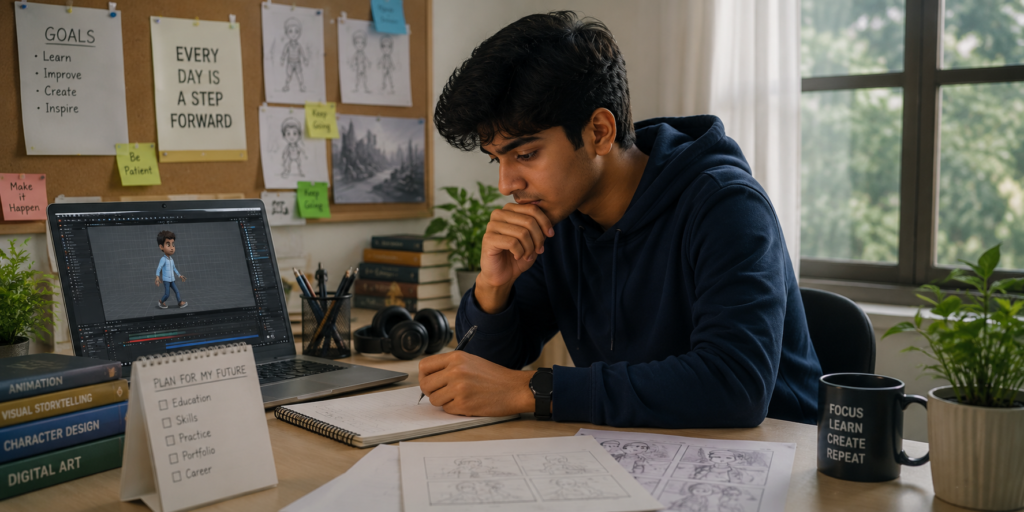
Some design-focused institutes ask for a portfolio, a collection of your drawings, sketches, or any creative work. Even if not mandatory, submitting a portfolio shows initiative and can help you stand out during the admission process.
Animation Course Fees and Duration: What to Budget For
Fees vary widely depending on the type of institution and the level of course.
Here is an honest overview to help you plan.
| Course Type | Duration | Fee Range (p.a.) | Mode |
|---|---|---|---|
| Certificate Course | 3–6 months | Click here | Online / Offline |
| Diploma Course | 1–2 years | Click here | Offline preferred |
| 3D Animation (Private Training Institute) | 6 months–2 years | Click here | Offline / Hybrid |
Additional costs to factor in include software licensing (unless the institute provides it), material costs for projects, and internet or equipment expenses if you are studying remotely. Always ask the institute for a full fee breakdown upfront, not just the admission fee.
Government-affiliated institutions like NIELIT are significantly more affordable and offer recognised certifications. Private institutes like Arena Animation, MAAC, and Morph Academy may cost more but often have better placement infrastructure.
Career Paths and Salary After Completing an Animation Course
One of the most practical questions any student should ask before choosing a course is: what jobs will I actually get? Here is a realistic picture.
Common Job Roles
- 3D Animator: Creates character and object movement in digital environments. Works in film, gaming, and advertising studios.
- 2D Animator / Illustrator: Produces frame-by-frame animation for children’s media, social content, and explainer videos.
- VFX Artist: Integrates CGI into live-action footage. Highly sought after for OTT content production.
- Motion Graphics Designer: Designs animated title sequences, broadcast graphics, and marketing videos.
- Game Designer: Builds characters, environments, and interactive elements for mobile or console games.
- 3D Modeller: Creates three-dimensional assets for films, games, and architectural visualization.
- Art Director: Oversees the visual language of a project, from concept to final frame.
- UI/UX Animator: Designs micro-animations for apps and websites. A fast-growing niche.
Salary Expectations
Freshers entering the animation industry in India can expect INR 2–4 lakh per year in the early years. With 3–5 years of experience and a strong portfolio, this typically grows to INR 4–7 lakh. Senior animators, art directors, and VFX supervisors with 6 or more years of experience often earn above INR 10 lakh annually.
Studios that regularly hire animation graduates include Tata Elxsi, Prime Focus, DQ Entertainment, Reliance Animation, Technicolor, and Prana Studios. IT and media companies also hire motion graphics artists and UI animators regularly.
How to Choose the Right 3D Animation Training Institute?
Choosing a 3D animation institute is not the same as choosing a regular college. You need to evaluate it on very specific parameters because the output, your skill set and portfolio, will directly determine your employability.
What to Look for
- Software and Lab Infrastructure: Does the institute have updated computers with licensed copies of Maya, 3ds Max, Blender, or After Effects? Ask specifically, some institutes teach on outdated versions.
- Faculty Experience: Are the instructors working professionals or people who have spent time in actual studios? Real-world experience translates directly into better teaching.
- Curriculum Relevance: Is the course content updated to reflect current industry practices? A 3D animation training institute teaching techniques from 5 years ago is a red flag.
- Portfolio and Demo Reel: Does the institute help you build a professional demo reel by the end of the course? This is your actual job application tool.
- Placement Support: Does the institute have active relationships with studios and media companies? Ask for placement statistics, not just promises.
- Batch Size: Smaller batches mean more hands-on attention. Avoid institutes where 40–50 students share one computer lab.
Red Flags to Watch Out For
- Institutes that push admission before you can visit the facility
- No option for a demo class or trial session
- Vague answers about placement records
- Faculty with no professional animation background
- Courses that are entirely theory-based with minimal software time
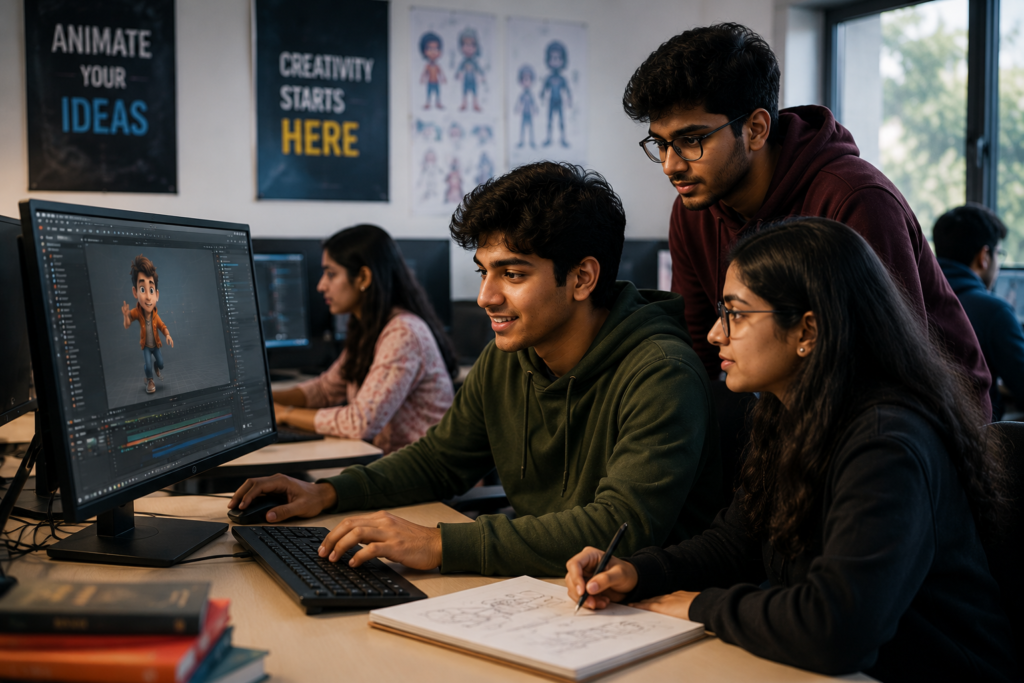
3D Animation Courses in Chandigarh: Institutes, Curriculum & Placement
Chandigarh has quietly become one of the stronger cities in North India for animation education. Students from Punjab, Haryana, Himachal Pradesh, and even parts of Rajasthan come here specifically for animation training because the city has a mix of established academies, government-recognised programs, and private 3D animation institutes with genuine placement support.
What the Chandigarh Animation Scene Looks Like?
There are currently around 14 to 28 institutes in and around Chandigarh offering some form of animation or multimedia education, ranging from short certificate programs to three-year undergraduate degrees. Private institutes dominate this space, though government bodies like NIELIT (National Institute of Electronics and Information Technology) also run structured programs at more accessible fee points.
3D animation course fees in Chandigarh typically range from INR 30,000 to INR 2,50,000 depending on the program length and institute reputation. This is generally lower than similar programs in Delhi or Mumbai while offering comparable quality.
Notable Institutes in Chandigarh
- Morph Academy: One of the more recognised names in Chandigarh for animation training, with a focus on 3D animation, VFX, and film making. They offer government-approved programs and report strong placement numbers backed by industry partnerships.
- Arena Animation (Sector 34): A national chain with a solid Chandigarh presence. Offers structured programs in 3D animation, VFX, game design, and AR/VR. Their labs use high-spec hardware and the curriculum is updated regularly.
- MAAC Chandigarh: Specialises exclusively in animation-related courses including 3D animation, visual effects, and gaming. Known for one-to-one mentoring, though fees are on the higher side.
- NIELIT Chandigarh: Government-run, affordable, and reliable for certification programs. Best suited for students who want a recognised credential at a lower cost.
- SXILL Chandigarh: Offers short-term programs in 3D animation, UX/UI design, and game development. Conducts career guidance sessions alongside the curriculum.
What You Should Expect From a Chandigarh Animation Program?
A good 3D animation course in Chandigarh should give you hands-on time with software like Autodesk Maya, Adobe After Effects, Blender, and ZBrush. You should be working on actual projects, not just exercises, and by the end of the program, you should have a demo reel or portfolio that you can take to studios.
Placement support is something to investigate carefully. Some institutes have genuine corporate partnerships, while others simply maintain a list of company names on their website without active placement coordination. Ask for specific placement statistics, number of students placed, companies they went to, and average starting salary.
If you are from Punjab, Mohali, or the broader Chandigarh tricity region, studying locally makes sense both financially and practically. The presence of multiple IT companies, media firms, and advertising agencies in Chandigarh also means internship and entry-level job opportunities are closer than you might think.
Frequently Asked Questions?
Q1: Can I do an animation course after 10th without any prior drawing experience?
Yes, Most certificate-level animation courses after 10th are designed for complete beginners. Drawing skills help but are not a prerequisite. You will develop foundational art skills as part of the curriculum.
Q2: Which stream should I choose in 11th if I want to pursue animation after 12th?
There is no mandatory stream. Animation institutes accept students from Science, Commerce, and Arts backgrounds. That said, Arts students are sometimes more comfortable with foundational design concepts, but it does not put other streams at a disadvantage.
Q3: Is a 3-year degree better than a 1-year diploma for animation?
It depends on your goal. A diploma gets you job-ready faster and at lower cost. A degree is better if you want to work in senior creative roles, pursue higher education, or join a government-sector organisation that requires a formal degree qualification.
Q4: What is the fee for a 3D animation course in Chandigarh?
3D animation course fees in Chandigarh range from INR 30,000 to INR 2,50,000 depending on the institute and course duration. Government institutes like NIELIT charge significantly less than private academies. Always ask for a full breakup including any additional costs.
Q5: Do animation institutes in Chandigarh offer placement assistance?
Several do, including Morph Academy, Arena Animation, and MAAC Chandigarh. However, the quality of placement support varies. Ask the institute for specific numbers, how many students from the last batch were placed, in which companies, and at what salary range.
Q6: Is animation a good career choice for a student from a small town in Punjab?
Absolutely. Geographic location matters less and less in animation because a large portion of the work can be done remotely. A student trained in Chandigarh can work for a studio in Mumbai, Hyderabad, or even internationally. The key is the quality of training and the strength of your portfolio.
Q7: What software will I learn in a 3D animation training institute?
Standard tools taught at reputed 3D animation institutes include Autodesk Maya, Autodesk 3ds Max, Blender, Adobe After Effects, ZBrush, and sometimes Unreal Engine or Unity for game-related tracks. Confirm with the institute that the software version being taught is current.
Q8: Can I pursue an animation course online after 12th?
Yes, several platforms and institutes offer online animation courses. However, for 3D animation specifically, offline or hybrid learning is recommended because you benefit significantly from direct mentorship, physical lab access, and collaborative project work. Online works better for 2D, motion graphics, and basic multimedia skills.
Q9: What is the scope of animation in India in the next 5 years?
The scope is strong. India’s animation and VFX industry was valued at approximately USD 1.75 billion in 2022 and is projected to grow at a CAGR of 17–19% through 2027. OTT platforms, gaming, ed-tech, and AR/VR applications are the primary growth drivers. Skilled animators will find consistent demand.
Q10: Is MAAC or Arena Animation better for a 3D animation course in Chandigarh?
Both are established institutes with national reputations. MAAC focuses exclusively on animation and VFX, while Arena Animation offers a broader media and design curriculum. The better choice depends on your specific interest, pure animation and VFX (MAAC) versus a wider creative skillset (Arena). Visit both, ask to see student portfolios, and compare the placement track records before deciding.
Visit Our Institute in Chandigarh 34A
Conclusion: Your Animation Career Starts Now
Whether you are finishing 10th or stepping out of 12th class, animation offers one of the most direct paths from creative interest to a real career. The industry is growing, the jobs are real, and the training infrastructure in Chandigarh is solid enough to get you there.
Take the time to visit institutes, ask hard questions about software access and placement records, and choose a program that builds your skills, not just your certificate collection. A good 3D animation training institute will not just teach you Maya or After Effects; it will teach you how to think like a professional animator.
Your next step is a campus visit or a demo class. Book one this week, decisions made in motion always move faster than decisions made in planning mode.